30.10.2026 — Summary. Since late September 2026, OpenAI, Anthropic and Google have been presenting AI agents that work continuously: they sort messages, prepare documents and sometimes pay for a purchase. To do so, they ask for access to your accounts. Here is a recap of what they do, with which safeguards, and what is available from Switzerland.
Updated on 30.10.2026
We all know conversational assistants: they answer when we ask them questions, we get ideas from them, they correct our emails, and so on. In this article we are talking about AI agents: the ones you can configure to take care of tasks for you, with varying degrees of autonomy that let them work independently. Here is a concrete example, our own. At nuclai, web communication is currently handled, under my supervision, by a team of 5 agents, see below:
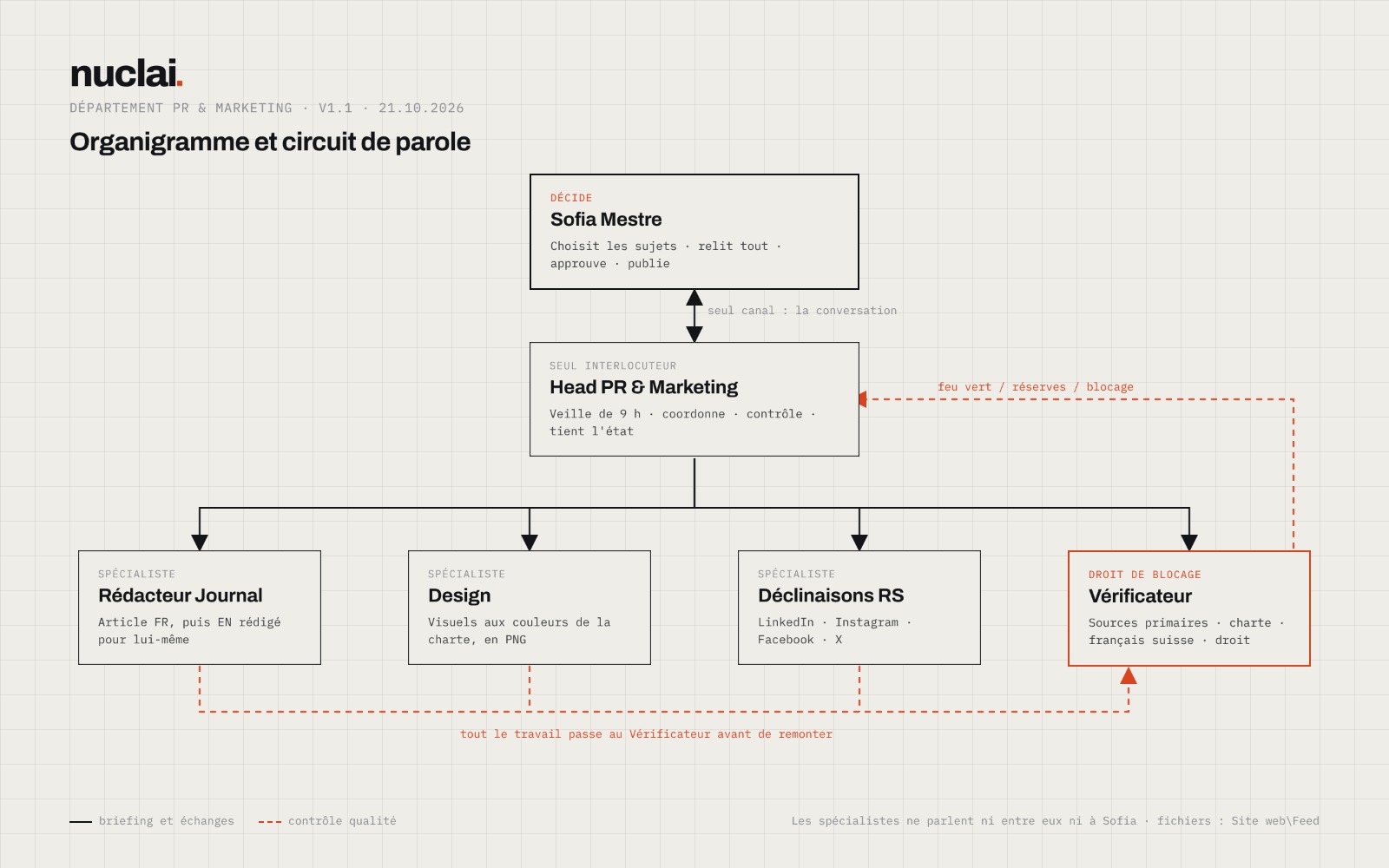
An AI agent, properly configured and with one or more precise roles, acts: it opens a website, fills in a form, sends a message or sets up a meeting, compiles a press review, proposes topics, checks working methods and improves continuously when that requirement is set in its skill. A new generation has arrived: it stays active in the background, even when nobody is talking to it. Some of you may wonder what the advantages are of working with a team of agents rather than firing off a precise request to ChatGPT: the quality of the outputs, because each agent specialises in its own field, and the organisation of workflows for efficiency gains, a clear process structure and a single point of contact who handles requests within the department. Now the AI giants are offering us their own pre-configured agents.
In this new episode of the AI giants’ race, what do they say about the advantages of these new agents?
In late September, OpenAI launched Dots. Each “dot” has its own computer and its own browser in the cloud. You can talk to it in ChatGPT, call it, or write to it in Slack and Microsoft Teams.
In early October, Google announced the Gemini agent for businesses. It receives its own Workspace account: an email address, a calendar, a Drive and a place in the company directory.
In late October, Anthropic introduced Claude Duet. Every morning, it sends a short update on what it considers important to monitor or do in the connected apps, and it tracks progress throughout the day. Among the examples Anthropic cites: scheduling meetings, spotting unpaid invoices in QuickBooks or Stripe and preparing reminders. We have not tested these agents; for now, ours are doing rather well.
What do they need to work?
These agents are only useful if they get into the tools where the work happens: email, calendar, accounting software, or even a means of payment. We no longer hand them a question, but access through pre-configured APIs.
Safeguards vary from one product to another, but the principle to apply when giving access to our apps is the same for every type of use: human in the loop before sensitive actions, and a very precise autonomy net when we let them act autonomously.
- Approval before sensitive actions. Claude Duet shows what it intends to do and waits for approval before sending a message, paying, signing a document or deleting anything. Trading securities or transferring money between accounts remains blocked, even with approval. At OpenAI, the user chooses for each type of action whether the dot acts alone or asks first; password changes and transfers always remain with the user.
- Controlled payment. For a purchase, Claude Duet uses a single-use virtual card from Link (Stripe), limited to one merchant and one amount.
- Spending cap. At Google, you can set a limit on a project’s AI spending. Once the limit is reached, the agent pauses.
- Protected passwords. On 22.10.2026, 1Password launched 1Password for Agents. According to the company, the agent asks to use a login, the user approves on their device, and 1Password fills in the form without the agent seeing the password. We have not tested it.
What remains unclear?
Anthropic itself writes that its safeguards will sometimes let something through, and that an agent may misread a conversation thread or misjudge an urgency. It calls “approval fatigue” a real problem: after approving again and again, you end up approving without reading.
Disconnecting an app cuts off new access, but what the agent has learned from it stays in memory until it is reset. Finally, the web pages an agent visits may contain hidden instructions. The risk is being addressed, not eliminated.
Not to mention that an AI agent reads a website by downloading its source code or by simulating a browser to extract the raw text, and may come across sensitive cybersecurity data such as forgotten API keys, credentials in the HTML code, or paths to admin panels and exposed configuration files.
And in Switzerland?
In Switzerland, a freelancer cannot get a dot with an individual subscription. OpenAI’s Pro plans include it only for users located outside the European Economic Area, the United Kingdom and Switzerland. That leaves the Business Premium plan, depending on the region and the workspace conditions. Claude Duet is, for now, open only to Pro and Max subscribers in the United States, via a waiting list.
Among our neighbours, usage is growing. According to OpenAI, the number of weekly active users of its agentic tools Codex and ChatGPT Work in EU small businesses (200 users at most) has been multiplied by 8.1 since May 2026. This figure, published by OpenAI, concerns the EU.
What we take away
Handing a task to an agent starts with deciding what you open up to it: which accounts, which data, which budget, which actions without approval. These choices are as much a matter of AI governance as of technology.
Identifying the tasks where an agent saves time, and those you prefer to keep in hand, is the starting point of our marketing and financial process automation engagements. If the idea of handing the keys to your business to externally pre-configured AI agents seems risky to you, we are also here to set up your own network of internal agents, built to fit your needs.
By Sofia Mestre
Sources
- OpenAI Help Center, “Getting started with your dot”, accessed on 29.10.2026: https://help.openai.com/en/articles/20001530-getting-started-with-your-dot
- Preuve.ai, “ChatGPT Dots Review (2026)”: https://preuve.ai/blog/chatgpt-dots
- eesel AI, “OpenAI Dots explained: what always-on agents do, cost, and where they stop”, 01.10.2026: https://www.eesel.ai/blog/openai-dots
- OpenAI Developer Community, “Dots looks exactly like what I need – but it’s unavailable for Pro users in the EEA”, 30.09.2026: https://community.openai.com/t/dots-looks-exactly-like-what-i-need-but-it-s-unavailable-for-pro-users-in-the-eea/1402170
- Anthropic, “Introducing Claude Duet”, 21.10.2026: https://claude.com/resources/articles/claude-duet
- Anthropic, “Claude Duet Safety, Privacy, and Security”, 23.10.2026: https://claude.com/resources/articles/claude-duet-safety-privacy-and-security
- Google Cloud, Thomas Kurian, “Welcome to Gemini at Work 2026: Introducing the Gemini agent”, 08.10.2026: https://cloud.google.com/blog/products/ai-machine-learning/welcome-to-gemini-at-work-2026
- 1Password Community, “Introducing 1Password for Agents”, 22.10.2026: https://www.1password.community/announcements-52/introducing-1password-for-agents-25883
- iPhone in Canada, “1Password Now Lets AI Agents Sign In Without Seeing Your Passwords”, 22.10.2026: https://www.iphoneincanada.ca/2026/10/22/1password-for-agents-ai-sign-in/
- OpenAI, “The EU’s next chapter in AI is agentic”, 14.10.2026: https://openai.com/index/the-eus-next-chapter-in-ai-is-agentic/
- TechRadar, Craig Hale, “‘The EU’s next chapter in AI is agentic’ – new OpenAI report…”, 15.10.2026: https://techradar.com/pro/the-eus-next-chapter-in-ai-is-agentic-new-openai-report-claims-agent-use-is-on-the-rise-across-europe-but-it-still-has-some-way-to-catch-up-to-other-markets
- explainx.ai, “OpenAI EU agentic AI report”: https://explainx.ai/blog/openai-eu-agentic-ai-report-codex-chatgpt-work-small-business-8x-lithuania-slovenia-2026